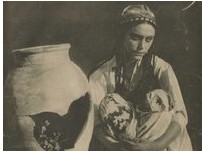
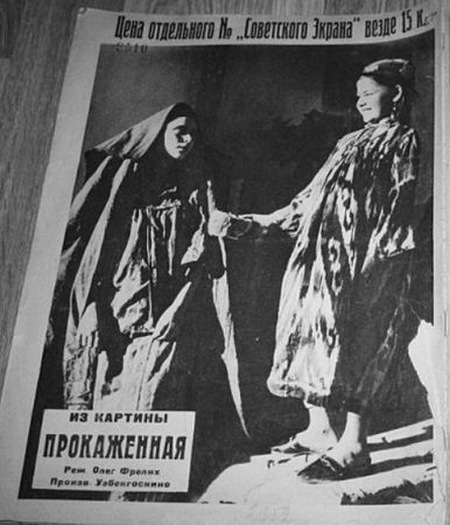
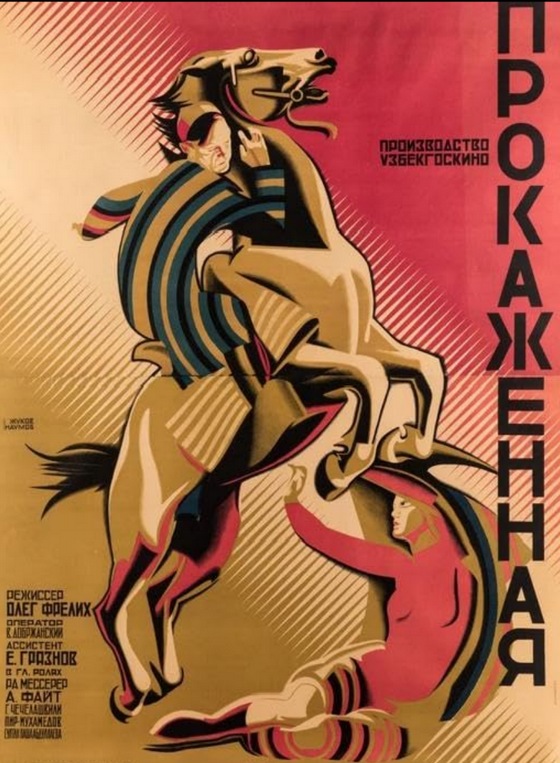
The film tells the story of a young girl, Tyllya-Oy, the daughter of a translator, married to Said-Vali. The young officer Igor Karenin seduces Tyllya-Oy and Said-Vali soon suspects her secret love. Driven from her home, the girl wanders the roads looking for a place to sleep and ends up in a leper camp. One day, going out onto the main road, Tyllya-Oy notices horsemen. She begs them to have pity on her and asks them to take her away, but they notice the inscription "Leper" on the post and, deciding that the girl is also sick, they whip her ...
Commentaries
Not long after co-writing the script for The Second Wife,
Lolakhan Saifullina adapted a French novel whose author,
Ferdinand Duchêne, also took women’s emancipation as a key
theme for his books. Duchêne was a magistrate in Algeria,
where he became fascinated by Arab and Berber culture and the
intersection between traditional life and modernity; his "Kamir.
Roman d’une femme arabe" first appeared in three issues of
La Petite Illustration (27.03, 03.04, 10.04.1926) before being
issued in book form shortly afterwards. Almost immediately it
was translated into Russian, twice, once as "Kamir" and then
as "New Moon" (Молодой месяц), as well as into Uzbek. It
can’t be a coincidence that the same year Saifullina wrote her
adaptation, the Bukharan writer and social activist Sadriddin
Ayni published his translation of Duchêne’s novel into Tajik.
Saifullina easily shifted Duchêne’s tragic love story between a
French officer and an Algerian woman to a sun-scorched town
in the Turkestan region at the beginning of the 20th century preserving some of the original’s plot
twists and imagery, most specifically
the impossibility for a woman to be
treated as an equal in a traditionbound society.
In the spirit of the Soviet era, the
film tells the story of a young girl
(once again played by Ra Messerer)
who, according to custom, marries
into a rich house at a young age.
Tyllia-Oi (the name means “golden”
in Uzbek) is close to the family of
Colonel Karonin, the Russian district
chief in Turkestan. At a party she
meets the rich merchant Said-Vali,
who makes her his wife, but his brutality leads her in desperation to ask
the Colonel for help. The message is
intercepted instead by the Colonel’s
son Igor, who seduces Tyllia-Oi.
When her husband discovers her
infidelity, he throws her out of the
house and takes her to a religious
court where he bribes the judges (in
Central Asia, unlike Arab countries,
Sharia divorce courts were uncommon). Shame forces Tyllia-Oi’s father
Akhmed-bai and his entire family to
leave their native land, but they are
unable to find peace in a new place,
and disasters follow one after the
other. Finally Akhmed-bai forces his
daughter out, and she stumbles upon
a leper colony. Horrified by what she
sees she runs into the road, but riders, convinced she must be a
leper, beat her to death.
Director Oleg Frelikh (1887-1953) had been an actor since
1914, turning to directing in 1924 and alternating between the
two for most of the decade. With The Leper, his sixth film, he
literally fills the screen with symbols, both in individual shots
and through montage. The transition from the talisman that the
mother sews for her daughter’s happiness to the billiard balls
assembled into the same triangle, which the heroine’s future
husband then smashes with a cue stroke, is a magnificent way
to foreshadow how this brutish man will also smash the young
heroine’s life.
Though Saifullina replaces Duchêne’s Arab girl with an Uzbek,
transposing French colonial power with Russian officials, the
script maintains much of the novel’s treatment of character and
its themes, from the atmosphere of misogynistic suspicion to the Sharia trial through to the death of the heroine. While the
idea of the Oriental woman oppressed by her despotic feudal
husband aligned with Soviet ideology, in the case of The Leper
the heroine’s tragic fate is determined not so much by social
motives but fatal bad luck, which dogs her from the moment she
marries until her terrible end. – Nigora Karimova