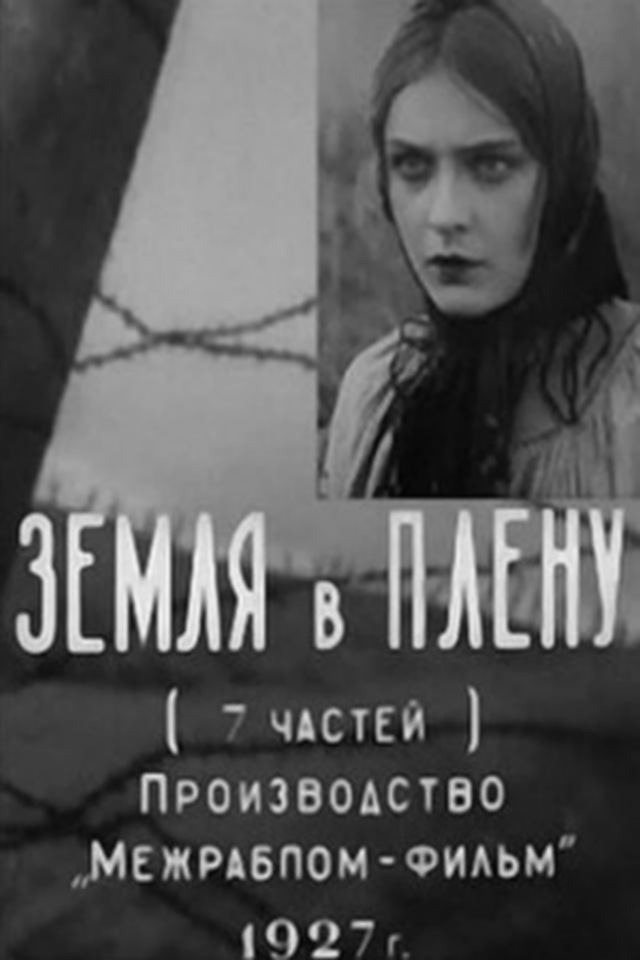
The life of peasants in pre-Revolutionary Russia. Soldier Yakov, having served his time, returns to his village. He dreams of settling down and making his family happy. But for their small farm to survive, his wife Marie agrees to be the wet nurse of a notable's child. But once in town, Marie is not only the wet nurse of the notable's child. Subjected to his unwanted advances, she runs away. But she is caught in a raid. She is then given a document classifying her as a prostitute. Unable to read, she presents this document to prospective employers and finds no work. Rejected everywhere, she falls into destitution.
Commentaries
The film was released in France in 1928 under the title Une femme qui tombe (A Woman Who Falls). The press at the time criticized its biased tone, which used a familiar subject to denounce prejudices and "bourgeois" morals. In their opinion, the film aimed to be an indictment of pre-war Russian society but proved nothing. However, cuts are recommended to remove the propagandistic tone from what is nonetheless a remarkable film, as it contains many excellent elements. Among the positive aspects are: the excellent technique, the beautiful cinematography, the depictions of peasant life, the portrayals of misery and vice, the moving scenes, the masterful direction, and Anna Sten's natural and understated performance.
Anna Sten, the unforgettable Girl with a Hatbox (1927) by Boris Barnet. At the unconventional Mezhrabpom studio in Moscow, Ozep and Barnet collaborated on the serial Miss Mend (1926). Since then, Barnet's fame has overshadowed Ozep's. This is a shame. Ozep was a talented screenwriter – The Queen of Spades in 1916 and Aelita in 1924 for Yakov Protazanov, and The Cigarette Girl at Mosselprom in 1924 for Yuri Zhelyabuzhsky. He was also a great director: The Brothers Karamazov (1931), Amok (1934)... In short, an auteur. Let's dare to be Ozep.