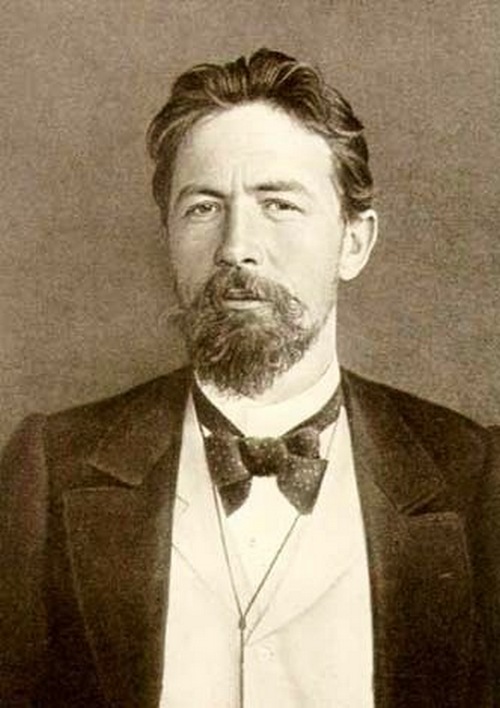
Chekhov was born on (17) 29 January 1860 in Taganrog, in a small adobe house on Police Street (now Chekhov Street), into the family of a third-guild merchant, owner of a grocery store, Pavel Yegorovich Chekhov, and (married since 28 October 1854) Yevgenia Yakovlevna Chekhova, née Morozova
Chekhov was the third child in a family of six children (another daughter died early): five sons and one daughter.
In his letter to the writer A. I. Ertel, A. P. Chekhov writes: ‘My surname also originates from the Voronezh region, from the Ostrogozhsky district. My grandfather and father were serfs of Chertkov.’ From 1840, Yegor Mikhailovich Chekhov worked at A. D. Chertkov's Olkhovatsky sugar factory. In 1841, the writer's grandfather bought his freedom, also buying his family's freedom from the landowner Chertkov. E. M. Chekhov was registered as a member of the Rostov bourgeoisie.
Chekhov's education began in the preparatory class of the Greek parish school in Taganrog in 1867. On 23 August 1868, he entered the preparatory class of the Taganrog Gymnasium, the oldest educational institution in southern Russia (founded in 1806 as a commercial gymnasium, and since 1866 as a classical gymnasium). It was at the gymnasium that his worldview and love of books and theatre were formed; it was here that he received his first literary pseudonym, ‘Chekhonte,’ which was given to him by his teacher of the Law of God, Fyodor Platonovich Pokrovsky; it was here that his first literary and theatrical experiments began. He was held back a second year in the third grade, receiving unsatisfactory grades in arithmetic and geography.
As a high school student, Chekhov published humorous magazines in which he wrote captions for drawings and wrote stories and sketches. He wrote his first play, Fatherlessness, at the age of 18 while studying at the gymnasium. This period in Chekhov's life was an important stage in the maturation and formation of his personality and the development of his spiritual foundations, providing him with a wealth of material for his writing. The most typical and colourful characters would later appear in his works. Perhaps one of these characters was his mathematics teacher Edmund Dzerzhinsky, the father of F. E. Dzerzhinsky, the future first chairman of the Cheka.
In 1876, Chekhov's father went bankrupt, sold his property in Taganrog, including his house, to pay off his debts, and left for Moscow to escape his creditors. Anton was left without a means of subsistence and earned his living by giving private lessons.
In 1879, he graduated from the gymnasium in Taganrog, moved to Moscow and enrolled in the medical faculty of Moscow University (now the First Moscow State Medical University named after I. M. Sechenov), where he studied under renowned professors: N. V. Sklifosovsky, G. A. Zakharin and others. In the same year, Anton's brother Ivan got a job as a teacher in the town of Voskresensk near Moscow. He was allocated a large apartment that could accommodate the whole family. The Chekhovs, who lived in cramped conditions in Moscow, came to visit Ivan in Voskresensk for the summer. There, in 1881, Anton Chekhov met Dr. P. A. Arkhangelsky, head of the Voskresensk Sanatorium (Chikinskaya Hospital). From 1882, while still a student, he began assisting the hospital's doctors in seeing patients. In 1884, Chekhov graduated from university and began working as a district doctor at the Chikinsky Hospital.
In March 1880, as a first-year student, Chekhov published the story ‘Letter to a Scholar Neighbour’ and the humorous piece ‘What is Most Commonly Found in Novels, Stories, etc.’ in the magazine Strekoza No. 10. This was his debut in print.
In 1882, Chekhov prepared his first collection of stories, ‘Mischief,’ but it was not published due to censorship difficulties. In 1884, a collection of his stories, ‘Tales of Melpomene’ (signed ‘A. Chekhonte’), was published.
In 1883, he became one of the founders of the Russian Gymnastics Society.
The years 1885–1886 marked the heyday of Chekhov as a ‘miniature fiction writer’ — the author of short, mostly humorous stories. At that time, by his own admission, he wrote one story a day. His contemporaries believed that he would remain in this genre, but in the spring of 1886, the writer received a letter from the famous Russian writer Dmitry Grigorievich, in which he criticised Chekhov for wasting his talent on ‘trifles’. ‘Better to starve, as we did in our time, and save your impressions for thoughtful work (...) One such work will be valued a hundred times more than a hundred wonderful stories scattered in newspapers at different times,’ Grigorovich wrote. Subsequently, Alexei Suvorin, Viktor Bilibin and Alexei Pleshcheyev joined Grigorovich in his advice. In the same year, the story ‘The Funeral Service’ appeared in Novoye Vremya, signed by An. Chekhov, and a second collection, ‘Motley Stories,’ was published.
In the late 1880s, Chekhov's style developed a feature that some contemporaries considered an advantage and others a disadvantage: a deliberate dispassionate description and a marked absence of the author's assessment. This feature is particularly evident in the stories ‘I Want to Sleep,’ ‘Women,’ and ‘The Princess.’
In 1889, Anton Chekhov's brother Nikolai died. In the same year, the writer began to think about taking up ‘painstaking, serious work.’ The decision to go to Sakhalin was finally made, apparently, in the summer of 1889, after discussing this intention with the actress K. A. Karatygina, who had travelled through Siberia and Sakhalin in the late 1870s. But Chekhov kept this intention secret for a long time, even from those closest to him; when he told Karatygina about it, he asked her to keep it a secret. He only revealed this secret in January 1890, which made a great impression on society. This impression was further heightened by the ‘suddenness’ of the decision, as Chekhov set off on his journey in the spring of that same year.
The journey through Siberia took 82 days, during which the writer wrote nine essays, collected under the title ‘From Siberia.’
From 1890 to 1895, after returning to Moscow from his trip to Sakhalin, Chekhov settled in a small two-storey wing on Malaya Dmitrovka. Here he worked on the book ‘The Island of Sakhalin,’ the stories ‘The Grasshopper,’ ‘The Duel,’ ‘Ward No. 6,’ and also met with writers V. G. Korolenko, D. V. Grigorovich, V. A. Gilyarovsky, P. D. Boborykin, D. S. Merezhkovsky, V. I. Nemirovich-Danchenko, famous actors A. P. Lensky and A. I. Yuzhin, and artist I. I. Levitan. The wing has been preserved to this day and is marked with a commemorative plaque with a bas-relief of the writer.
In 1894, Chekhov visited Paris, where he witnessed the unfolding scandal surrounding the Dreyfus Affair. Impressed by the events, he familiarised himself with the available materials and, convinced of Dreyfus' complete innocence, published several articles in his defence upon his return to Russia.
From 1892 to 1899, Chekhov lived in the Melikhovo estate near Moscow, not far from the village of Lopasnya (now the city of Chekhov, where one of the writer's museums operates). During the years of "sitting in Melikhovo," 42 works were written. Later, he traveled extensively throughout Europe. In 1899, he sold the rights to his works, which were written and would be written over the next twenty years, to the book publisher Adolf Marx for 75 thousand rubles.
At the end of 1898, the writer bought a plot of land in Yalta, where he laid out a garden and built a house designed by the architect L. N. Shapovalov. In his last years, Chekhov, whose tuberculosis had worsened, lived permanently in his house near Yalta to improve his health, only occasionally coming to Moscow, where his wife (since 1901), the actress Olga Leonardovna Knipper, occupied one of the outstanding places in the troupe of the Moscow Art Theater, founded in 1898. On December 6, 1899, by decree of Emperor Nicholas II, "the trustee of the Talezh rural school of the Serpukhov district Anton Chekhov" was awarded the Order of St. Stanislav, 3rd degree, the first, "initial" order in the hierarchy of awards of the Russian Empire for a civilian. As a "cavalier", he was to become a personal nobleman. However, the address to the recipient was formulated in the imperial decree as follows: "To our hereditary nobleman..."; thus, A.P. Chekhov, by this very fact of the royal address, acquired the rights of hereditary nobility and the right to be included in the 1st part (the so-called "granted, or actual" nobility) of the noble genealogical book of the Moscow province, since it was there that he had real estate.
In 1900, during the very first elections to the category of belles lettres of the Department of Russian Language and Literature of the Academy of Sciences, Chekhov was elected as an honorary academician in the category of belles lettres. In 1902, Chekhov, together with V.G. Korolenko, renounced the title of academician after the order of Emperor Nicholas II to cancel the election of Maxim Gorky as an honorary academician.
For a long time, it was believed that Chekhov died of tuberculosis. In the writer's medical history, which was kept at the clinic by his attending physician, Maxim Maslov, it is recorded that in his high school and student years Chekhov suffered from tuberculosis inflammation of the peritoneum, but he felt "tightness in the sternum" even at the age of 10. Since 1884, Chekhov suffered from bleeding from the right lung. In the summer of 1904, Chekhov went to a resort in Germany. On July 2 (15), 1904, the writer died in Badenweiler (Baden). The denouement occurred on the night of July 1-2, 1904. According to Olga Knipper-Chekhova, at the beginning of the night Chekhov woke up and "for the first time in his life he himself asked to send for a doctor. Afterwards he ordered champagne. Anton Pavlovich sat down and said loudly and meaningfully to the doctor in German (he knew very little German): “Ich sterbe.” Then he repeated for the student or for me in Russian: “I am dying.” Then he took the glass, turned his face to me, smiled his amazing smile, said: “I haven’t had champagne for a long time…,” calmly drank it all to the bottom, quietly lay down on his left side and soon fell silent forever.”