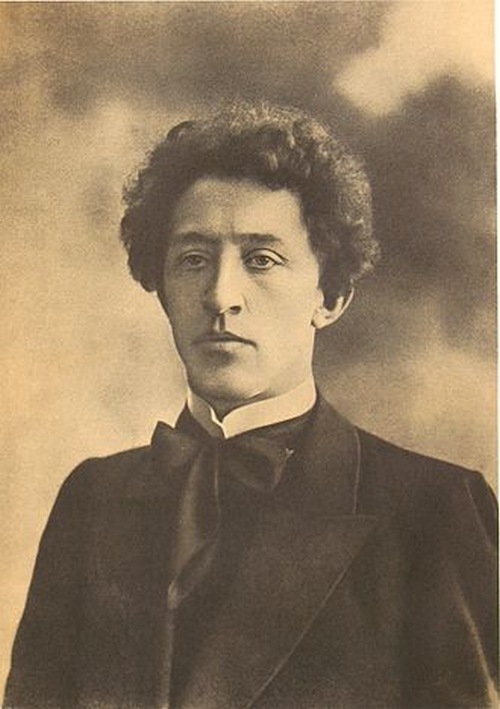
Alexander Alexandrovich Blok (1880–1921) was an outstanding Russian poet, playwright, and essayist, and one of the most prominent representatives of Symbolism in Russian literature. His work had a significant influence on the development of 20th-century poetry.
Early Years and Education
Alexander Blok was born on November 28, 1880, in Saint Petersburg, into an intellectual family. His father, also named Alexander Blok, was a professor, and his mother, Elizaveta Blok, was a teacher. From childhood, Blok showed an interest in literature and art, which was nurtured by his well-educated family.
In 1898, he entered the Faculty of Law at Saint Petersburg University, but soon abandoned his studies to focus on literary work. During this period, he began writing poetry actively and became acquainted with members of the literary bohemia.
Literary Career
Blok’s first poetry collection, Verses about the Beautiful Lady, was published in 1904 and immediately attracted readers’ attention. In it, he expressed his ideas about love, beauty, and the ideal—elements that became characteristic of his work. Blok emerged as one of the leading Symbolists, and his poetry was marked by musicality, vivid imagery, and deep philosophical reflections.
In 1908, his famous collection The Stranger was released, cementing his reputation as one of the brightest poets of his time. His verse often contains themes of love, beauty, loneliness, and tragedy. Blok also experimented with form and style, making his poetry distinctive.
Political Views and the Revolution
Blok witnessed the revolutionary events in Russia and actively responded to them in his works. In 1917, after the February Revolution, he supported the idea of change but soon became disillusioned with the Bolsheviks. His poetry began to reflect the crisis and turmoil brought about by the revolution and the civil war. During this time, he wrote works such as The Twelve (1918), in which he expressed his contradictory feelings toward the revolution.
Personal Life
Blok was married to Lyubov Dmitrievna Mendeleeva, with whom he had a daughter, but their marriage was difficult. The poet’s personal life was full of suffering and conflict, which was also reflected in his work. He often experienced creative crises and doubts about his calling.
Later Years and Death
In the 1920s, Blok continued to write, but his health began to decline. He suffered from tuberculosis and endured personal and creative hardships. On August 7, 1921, he died in Petrograd (now Saint Petersburg) at the age of 40.
Legacy
Alexander Blok left an important legacy in Russian literature. His poetry influenced many subsequent poets and writers, including Anna Akhmatova and Osip Mandelstam. Blok is considered one of the greatest Russian poets, and his works continue to be studied and valued for their depth, artistic expressiveness, and philosophical richness. His creativity became a symbol of an era and a reflection of the complex processes taking place in Russia in the early 20th century.