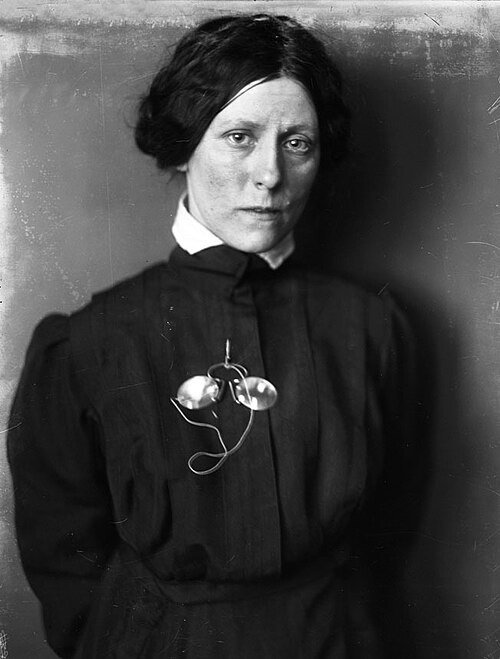
Early Years
Maria Spiridonova was born on October 16 (28), 1884, in Tambov, into the family of a collegiate secretary. In 1902, she graduated from the Tambov Women’s Gymnasium, though according to other sources she was expelled for political unreliability. After finishing school, she worked as a clerk for the provincial noble assembly. During this time, she joined the local Socialist-Revolutionary (SR) organization and entered the party’s combat unit.
Political Activity and Assassination Attempt
Spiridonova actively participated in revolutionary activities and became known for her radical approach. On January 16, 1906, she carried out an assassination attempt on Gavriil Luzhenovsky, a councillor of the Tambov provincial administration who had brutally suppressed peasant uprisings. Spiridonova shot him at the railway station in Borisoglebsk, after which she attempted suicide but was arrested.
Imprisonment and Hard Labor
After her arrest, Spiridonova was subjected to brutal torture in prison. She was sentenced to death, but the sentence was later commuted to life at hard labor due to a diagnosis of tuberculosis. She spent 11 years in the Nerchinsk penal labor camps, where conditions were extremely harsh. In 1917, after the February Revolution, Spiridonova was released.
After the Revolution
Upon her release, she returned to Moscow and became an active participant in political life. Spiridonova revealed strong oratorical skills and quickly gained popularity among peasants. She was elected to the Constituent Assembly as a representative of the Socialist-Revolutionary Party (SRs).
Conflict with the Bolsheviks
After the Bolsheviks came to power, Spiridonova and her party faced repression. Initially, the Bolsheviks attempted to maintain relations with the Left SRs, but disagreements regarding agrarian policy and other issues soon led to conflict. Spiridonova and her supporters opposed Bolshevik policies, which ultimately resulted in their persecution.
Death
Maria Spiridonova died on September 11, 1941, in the Medvedev Forest near Oryol. Her life and work left a significant mark on the history of the Russian socialist movement.
Ideas and Legacy
Spiridonova advocated radical methods in the struggle for the rights of peasants and women. She believed that only through violence could justice be achieved under conditions of oppression. Her life became a symbol of the fight for social rights and political freedom, and her ideas about equality and justice remain relevant today.
Open Letter by Maria Spiridonova, November 1918, to the Central Committee of the Bolshevik Party:
(Translated below in full)
“You have placed yourselves in the camp of rebels against Soviet power—the only power of real strength in Russia—through your cynical attitude toward the Soviets, your White-Guard dispersals of congresses and Soviet meetings, and the unchecked arbitrariness of Bolshevik appointees. Despite all its chaos, Soviet power represents a greater and better expression of the people’s will than the entire Constituent Assembly, the Duma, or the Zemstvos. The Soviets are an apparatus of self-government for the working masses, sensitively reflecting their will, moods, and needs.
When every factory, mill, and village had the right, through the re-election of its Soviet delegate, to influence the work of the state apparatus and to defend its interests, both general and specific, that truly was self-government. Any arbitrariness and violence, any errors natural during the first attempts of the masses to govern and manage themselves, were easily curable, because the principle of unlimited re-electability and the people’s power over their representative made it possible to correct him radically—by replacing him with someone more honest and better known throughout the village or factory.
And when the working people beat their Soviet delegate for deceit and theft—then so be it, even if he is a Bolshevik. The fact that you send artillery into the countryside to defend such scoundrels, guided by a bourgeois notion of the authority of power, proves that you either do not understand the principle of workers’ power or do not recognize it. And when peasants disperse or kill violent appointees—this is precisely Red Terror: the people’s self-defense against violations of their rights, against oppression and violence.
And if the masses of a given village or factory send a right-wing socialist as their delegate—so let them; it is their right, and it is our misfortune if we failed to earn their trust. For Soviet power to be like a barometer—sensitive and tightly bound to the people—unlimited electoral freedom is necessary, the play of popular elemental forces; then creativity, new life, new order, and struggle will be born. Only then will the masses feel that everything happening is their own affair, not something foreign. That they themselves are the creators of their destiny, and not someone who patronizes them, bestows favors upon them, or advocates for them, as in the Constituent Assembly or other parliamentary institutions. And only then will they be capable of boundless heroism.
That is why we fought you when you expelled right-wing socialists from the Soviets and the All-Russian Central Executive Committee. The Soviets are not only a militant political-economic organization of the working people, but also a defined platform—a platform for destroying all foundations of the bourgeois-serf order. And if right-wing delegates attempted to preserve or defend that order within the Soviets, the very nature of this organization would have broken them, or the people would have expelled them themselves—not your Cheka—as traitors to their interests.
The program of the October Revolution, as it has taken shape in the minds of the working people, is still alive in their hearts; the masses have not betrayed themselves—you have betrayed them.
Your contempt for the workers’ right to elect their own delegates and Soviet officials, revealed in the crude machine-gun arbitrariness seen even before the July reaction—when you repeatedly rehearsed the dispersal of Soviet congresses as soon as you saw our strengthening—will yield rich fruit for right-wing parties. You have accustomed the people so thoroughly to powerlessness, created such habits of submissive obedience to any raids, that an Avksentiev-American-Krasnov dictatorship could pass like a knife through butter.
Instead of free, shifting, living creativity of the people—like light, like air—through change and struggle in the Soviets and at congresses, you have appointees, constables, and gendarmes from the Communist Party.”