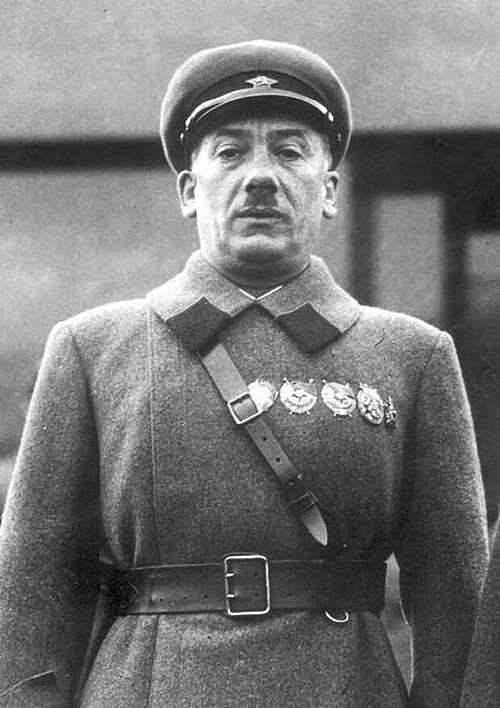
Genrikh Grigoryevich Yagoda (1891–1938) was a Soviet state and party official, one of the founders and leaders of the USSR’s state security organs. He is known for his role in the creation and management of the OGPU (Joint State Political Directorate) and the NKVD (People’s Commissariat for Internal Affairs).
Early Life and Education
Genrikh Yagoda was born on November 7, 1891, in Rybinsk, Yaroslavl Governorate, into a Jewish family. His father, Grigory Isaakovich Engin, was a small-scale merchant. Genrikh received his primary education at a Jewish school and later continued his studies at a commercial college in Moscow.
Revolutionary Activity
In 1911, Yagoda joined the Russian Social Democratic Labour Party (RSDLP) and became part of the Bolshevik faction. In 1912, he was arrested for revolutionary activity and exiled to Siberia, from where he escaped in 1914. After the February Revolution of 1917, Yagoda returned to Petrograd and actively participated in revolutionary events.
Career in the Security Organs
After the October Revolution of 1917, Yagoda began working in the state security organs. In 1918, he was appointed deputy chairman of the Cheka (All-Russian Extraordinary Commission) in Moscow. In 1923, Yagoda became deputy chairman of the OGPU, and in 1934 he became the People’s Commissar for Internal Affairs (NKVD) of the USSR.
Leadership of the NKVD
As People’s Commissar for Internal Affairs, Yagoda played a key role in the repressive policies of Stalin’s regime. Under his leadership, the NKVD carried out mass arrests, executions, and deportations. Yagoda was also responsible for organizing and conducting the first show trials of “enemies of the people,” including the trials of the “Industrial Party” and the “Trotskyist-Zinovievite Center.”
Downfall and Arrest
In 1936, Yagoda was removed from his post as People’s Commissar for Internal Affairs and appointed People’s Commissar of Communications. In 1937, he was arrested on charges of espionage, sabotage, and participation in an anti-Soviet conspiracy. At the Third Moscow Trial in 1938, Yagoda was found guilty and sentenced to death. The sentence was carried out on March 15, 1938.
Personal Life
Genrikh Yagoda was married to Ida Aronovna Averbakh, with whom he had two children. His personal life was closely linked to his career in the state security organs, and he often used his connections to advance professionally.
Legacy
Genrikh Yagoda remains one of the most controversial figures in Soviet history. On the one hand, he was among the founders and leaders of the state security organs that played a key role in establishing and maintaining Stalin’s regime. On the other hand, his activities were associated with mass repression and human rights violations.