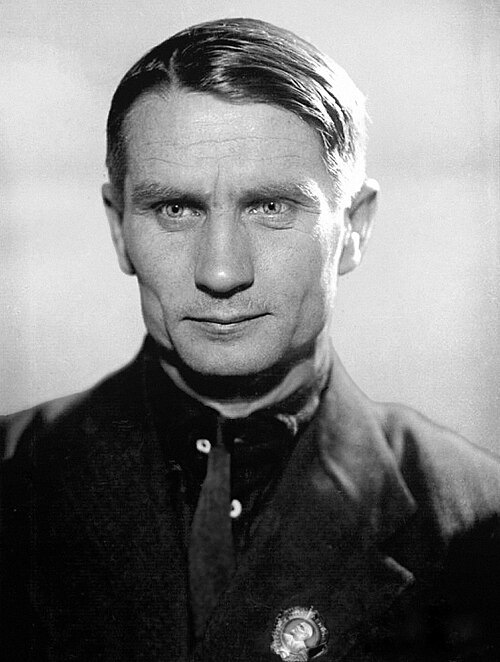
Trofim Denisovich Lysenko (1898–1976) was a Soviet agronomist and biologist known for his pseudo-scientific theories in the fields of genetics and plant breeding. Despite their scientific inconsistency, his ideas received considerable support from the Soviet government and were officially endorsed in the USSR during the 1940s and 1950s.
Early Life and Education
Trofim Lysenko was born on September 29, 1898 (September 17, Old Style), in the village of Karlovka, in the Poltava Governorate (now in Ukraine), into a family of peasants. In 1915, he entered the Kyiv Agricultural Institute, but his studies were interrupted by the First World War. In 1917, Lysenko was conscripted into the army, where he served until 1921.
Early Scientific Career
After his demobilization, Lysenko resumed his studies at the Kyiv Agricultural Institute, from which he graduated in 1925. In 1927, he began working at the Ukrainian Institute for Research in Plant Breeding and Seed Production, where he conducted his first experiments in plant selection.
Main Ideas and Theories
Lysenko developed several pseudo-scientific theories that contradicted the fundamental principles of genetics. Among them were:
Vernalization: Lysenko claimed that plants could be hardened by exposure to cold in order to accelerate their growth and development. He conducted experiments on the cold treatment of seeds and plants, asserting that this method made it possible to obtain more resilient and higher-yielding varieties.
Inheritance of Acquired Characteristics: Lysenko argued that acquired traits, such as cold hardiness, could be transmitted to subsequent generations. This directly contradicted the basic principles of genetics formulated by Gregor Mendel and further developed in the early twentieth century.
Genetic Plasticity: Lysenko maintained that plants could alter their genetic properties in response to environmental conditions.
Government Support
Lysenko’s ideas enjoyed significant support from the Soviet government, particularly under Stalin’s rule. In 1940, Lysenko was appointed director of the Institute of Genetics of the USSR Academy of Sciences, and in 1948 his theories were officially recognized in the Soviet Union. That same year, at a session of VASKhNIL (the Lenin All-Union Academy of Agricultural Sciences), genetics was declared a “bourgeois pseudoscience,” and all research in this field was banned.
Consequences and Criticism
Lysenko’s ideas had severe consequences for Soviet science and agriculture. Many scientists involved in genetics were repressed, and research in this field was halted. This led to significant losses in agriculture and delayed the development of genetic research in the USSR.
Decline and Death
After Stalin’s death in 1953, Lysenko’s influence began to wane, but his ideas continued to affect Soviet science until the late 1960s. Lysenko died on November 20, 1976, in Moscow.
Legacy
Trofim Lysenko remains one of the most controversial figures in the history of science. His ideas, despite their pseudo-scientific nature, had a profound impact on the development of Soviet science and agriculture. Today, his legacy is regarded as a cautionary example of how political ideology can influence scientific research and lead to serious consequences.