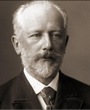
Pyotr Ilyich Tchaikovsky, born on 7 May 1840 in Votkinsk and died on 6 November 1893 in Saint Petersburg, was one of Russia's greatest composers and one of the leading figures of Romantic music.
After studying law and working for several years at the Ministry of Justice, he decided to devote himself to music. He studied at the Saint Petersburg Conservatory, notably under Anton Rubinstein, before becoming a professor at the Moscow Conservatory in 1866.
His work, which combines Russian musical traditions with European musical forms, is distinguished by its melodic richness, lyricism and dramatic power. He composed symphonies, concertos, operas, ballets, chamber music and numerous art songs.
Among his best-known compositions are the ballets Swan Lake, The Sleeping Beauty and The Nutcracker, the operas Eugene Onegin and The Queen of Spades, the Piano Concerto No. 1, the Violin Concerto and the Sixth Symphony, known as the Pathétique.
From 1877 onwards, the financial support of Nadezhda von Meck enabled him to devote himself more freely to composition. His reputation became international, and he undertook several tours as a conductor. He died at the age of fifty-three, just a few days after conducting the premiere of his final symphony.
Tchaikovsky and Russian and Soviet Cinema
Tchaikovsky's music occupies an important place in Russian and Soviet cinema, both through adaptations of his works and through their use in feature films, documentaries and animated films.
His operas have notably been adapted into genuine cinematic works, such as Eugene Onegin (1958) and The Queen of Spades (1960), directed by Roman Tikhomirov. His ballets, particularly Swan Lake and The Nutcracker, have also inspired numerous productions for the screen.
His music sometimes appears in contexts far removed from the world of ballet or opera. Thus, in Kidnapping, Caucasian Style (1967) by Leonid Gaidai, a television broadcast of Swan Lake accompanies a sequence of the film. The Sixth Symphony is also used in the short film Chapaev Is with Us (1941).
Tchaikovsky also appears as a character in several films, notably Tchaikovsky (1970) by Igor Talankin, starring Innokenty Smoktunovsky, and Tchaikovsky's Wife (2022) by Kirill Serebrennikov, which focuses on his marriage to Antonina Milyukova.
Through the expressive power of his music, the dramatic richness of his works and the place his personality occupies in Russian cultural history, Tchaikovsky remains an important presence in Russian cinema, from the Soviet era to the present day.