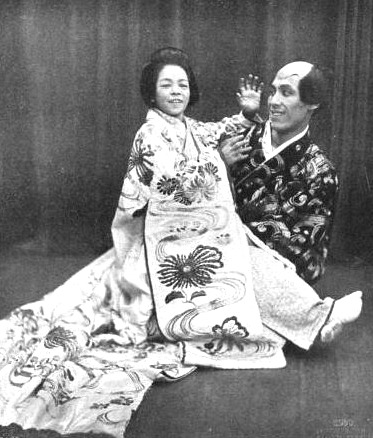
Prince Sataké asks his servant Akiki to take a batch of precious plates to his brother, Prince Tessan, but on the way, the servant becomes obsessed with the assiduity of Tchouta, Prince Tessan's servant. Luckily, her fiancé arrives in time to put an end to his insolence. But Tchouta is vindictive. To get back at Akiki, he deftly steals two of the plates she is to carry. When she arrives at the Prince's house, Akiki is astonished to discover that the two pieces of china have disappeared. Accused of theft by Prince Tessan, she is unable to persuade him of her good faith. She thinks that only death can save her honour, and poor Akiki, after writing her fiancé a letter in which she protests her innocence, cuts her carotid artery. Samney, warned by a merchant who had witnessed Tchouta's theft, arrives too late to save his fiancée, who dies in his arms.
Commentaries
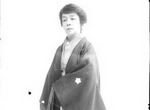
These two films ["The Love of a Japanese Woman" and "Better Death than Dishonour"] are the sole surviving moving pictures of the dancer and actress Ohta Hisa, known as Hanako (1868-1945); a photographic record of her performances also exists. Public infatuation with the diminutive Japanese artist (some reports describe her as 4 ft. 6) predates these films: “She is like a kitten, whose every movement is a success,” enthused the New York Times (27.10.1907). Hanako (“Little Flower”) was first spotted by the dancer and entrepreneur Loïe Fuller, who provided her with a repertoire of “suicide” pieces. American and European newspapers, especially the French ones, describe her hara-kiri enactments when she was performing in La Martyre at the Théâtre Moderne in Paris, also noting her facial expressivity when conveying love and jealousy.
Hanako’s style first fascinated France in 1906, around the time that Europe was discovering kabuki theatre (Rodin, who met her that year in Marseille, made her one of his models; she posed for over 50 of his works), and she returned to France during a tour in the 1910s. Her friendship with the wife of Albert Carré, director of the Opéra-Comique and cousin of Michel Carré, the film director at SCAGL, led to several performances of Madame Butterfly, which may have inspired the screen adaptation of La Petite geisha. In Moscow in 1912-1913, her sophisticated acting earned praise from Nikolai Evreinov and Vsevolod Meyerhold, and she performed before the students of the Art Theater. The newly christened Le Film Russe, registered in 1910, marked the transformation of the Moscow branch of Pathé into a local production company with its own studio. This initiative helped launch the careers of several young directors; Peter Bagrov and Anna Kovalova have recently posited that these two films with Hanako were probably directed by Yakov Protazanov rather than Kai Hansen.
These restorations were carried out in 2021 by the Fondation Jérôme Seydoux-Pathé and the Cinémathèque française, based on the original Pathé negatives. Editing and intertitles were reconstructed from the original scenarios and information on the prints. The 4K digital transfer was done by L’Immagine Ritrovata, Paris-Bologna.
– Stéphanie Salmon, Fondation Jérôme Seydoux-Pathé