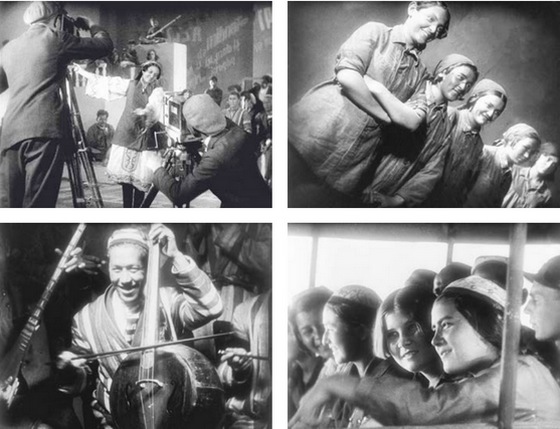
In theme, ideological orientation, and overall filmmaking
choices, Her Right is clearly designed as propaganda, made
to introduce and underline the Soviet regime’s policies and its campaign for reform.
At the end of the cotton harvest,
Gaukhar heads off to work in a factory with Komsomol (the Leninist political youth organization) members. Her friend
Tadzhi, dressed in the traditional paranja (an Uzbek burqa)
and chachvon (full face covering), desperately wants to join
her, but Tadzhi’s husband Kasym Iusupov follows the voice of
tradition and orders her to remain at home.
During the winter she defies her husband, throws off her chachvon, and flees on horseback and then by train towards liberation and the
factory, where she distinguishes herself by her socialist fervor
and becomes head of the women’s brigade.
In the factory, the women challenge the men to a competition
to see who can produce more; naturally the women win, and
Tadzhi urges all her fellow workers to demonstrate their
socialist ideals at the kolkhoz (collective farm).
A cameraman
captures her speech, and the workers triumphantly carry
the film reels to the farming community, where the movie is
screened. But Kasym is in the audience; seeing his wife in
Western clothing, unveiled before an audience, drives him
into a frenzy, and in the film’s climactic scene he pulls out
his dagger, rushes forward, and slices the screen where his
wife’s neck appears. The spectators restrain Kasym as the
film continues to play despite the slashed screen that makes it
appear as if Tadzhi’s throat has been cut. Repentant, Kasym
later goes to the factory to reconcile with his wife.
By the early 1930s, the concepts of “five-year plans” and “movements” associated with collectivization,
industrialization, the liberation of women of the East, the fight against illiteracy, etc., became a staple of Soviet
cinema. Director Grigorii Cherniak’s previous film, One
Hundred Twenty Thousand a Year (Sto dvadsat tysyach v
god, Сто двадцать тысяч в год, 1929), shot in Moscow for
Mezhrabpomfilm, similarly centered on a young woman
pitted against the forces of conservatism who triumphs over
benighted reactionaries when her textile production invention
significantly increases the factory’s output. Such stories were
actively promoted in the various Soviet Republics, where
studios produced films according to directives from Moscow
which not only determined themes and plots but also how
arguments should be emphasized, with official ideological
bodies issuing “methodological hints.”
Such a guide was prepared for Her Right, stating that “the
theme of the emancipation of Oriental women and their
involvement in the construction of socialism reflects one of the
most important tasks... Especially vital are questions about
work among national women [meaning women from national
republics – Uzbekistan, Tajikistan, Turkmenistan] still under
the influence of old laws and customs.” (Publishing House of the
USSR Cinematography Administration [Izdatelstvo Upravlenie
Kinofikatsiia], Moscow, 1931)
Nigora Karimova