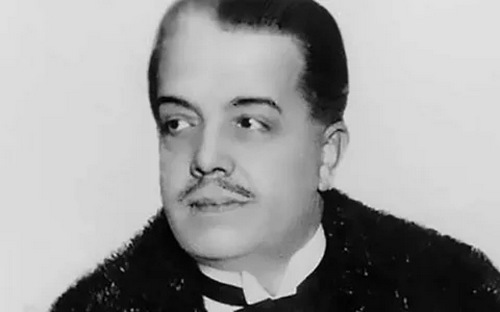
(March 19, 1872, Selishchi, Novgorod Governorate, Russian Empire – August 19, 1929, Lido Island near Venice, Kingdom of Italy) was a prominent Russian theatrical and artistic figure, a patron of the arts, and one of the most renowned personalities of the Silver Age.
He was a co-founder and chief ideologist (alongside Alexandre Benois) of the "Mir Iskusstva" (World of Art) movement and its namesake magazine. Diaghilev organized the “Russian Seasons” in Paris and founded the famous “Ballets Russes”, acting as impresario. He played a pivotal role in popularizing Russian art across Europe and the world at the turn of the 20th century, and discovered many talented ballet dancers, composers, and visual artists.
Diaghilev spent his youth in Saint Petersburg, where, while studying at university, he developed an interest in painting and became one of the founders of Mir Iskusstva. His career began with the successful organization of exhibitions featuring contemporary European and Russian artists. Upon entering the service of the Imperial Theatres, he was appointed editor of the Yearbook of the Imperial Theatres, which he transformed into a high-quality art publication with illustrations and literary articles.
In 1906, with the help of influential patrons, Diaghilev staged the first historical Russian concert in Paris, introducing Russian opera to French audiences. In 1909, he presented ballet for the first time. The overwhelming success of these productions sparked a “Russian craze” across Europe. His company’s tours became an annual event, gradually expanding beyond Paris to London, other European cities, the United States, and South America. After the 1917 revolutions, the company severed ties with Russia and continued to operate under the name “Diaghilev’s Ballets Russes” until his death in 1929.
Diaghilev had a rare talent for organization, a refined artistic taste, and an instinct for discovering new talent. Many artists and composers, as well as an entire generation of dancers, owed their international fame to him. At the same time, contemporaries remembered him as a controversial and complex figure who often broke personal agreements and financial obligations. Toward the end of his life, Diaghilev lost interest in ballet and turned to book collecting, amassing a library of rare editions.
The early seasons of Diaghilev’s ballet featured leading performers from the Imperial Theatres — Mikhail Fokine, Anna Pavlova, Vaslav Nijinsky, Bronislava Nijinska, Tamara Karsavina, Adolph Bolm, Ludmilla Schollar, Vera Karalli, and Lyubov Tchernysheva. From 1911 onward, the company officially took the name “Ballets Russes de Diaghilev”. Before World War I, opera was also part of the repertoire, with productions such as The Nightingale by Stravinsky, Prince Igor by Borodin, and May Night by Rimsky-Korsakov.
From the second ballet season in 1910, the troupe performed at the Paris Opéra (Palais Garnier), with Diaghilev presenting only world premieres to the Parisian public. That year saw productions of Giselle, Carnaval, Scheherazade, The Firebird, and Orientalia, with choreography by Fokine. Between 1910 and 1913, Igor Stravinsky acted as one of the company’s key artistic directors.
After Fokine, Diaghilev’s principal choreographers included Vaslav Nijinsky, Léonide Massine, Bronislava Nijinska, and George Balanchine. Until 1913, the ballet sets were designed mainly by artists from the Mir Iskusstva group, including Alexandre Benois, Léon Bakst, Alexander Golovin, Nicholas Roerich, and Boris Anisfeld. The dominant aesthetic of the time was that of Impressionism and the Belle Époque. With The Afternoon of a Faun, a new direction emerged — moving from neo-Romanticism to wild, expressive Fauvism. From the mid-1910s, Diaghilev radically changed the stylistic direction of his productions, abandoning exoticism and courtly opulence in favor of the avant-garde. The first work in this new style was the ballet Parade by Erik Satie, which premiered in Paris in 1917 and caused a public scandal. Diaghilev moved away from the Mir Iskusstva style and, living permanently in Europe, began working mostly with European artists, including émigrés Natalia Goncharova and Mikhail Larionov. For example, the ballet Jeux, set against a tennis match backdrop, featured costumes by French couturier Paquin and music by Claude Debussy.
From 1911 to 1914, Diaghilev’s troupe held six Russian Seasons in London. During the first tour, it became apparent that the British public reacted differently: the Polovtsian dances in Prince Igor were called “savage jumps,” the slave-master romance in Scheherazade was deemed improper, and Nijinsky was not applauded in Armide. However, romantic ballets, Bakst’s sets, and the star ballerinas Kschessinska and Pavlova were enthusiastically received.
In 1921, Diaghilev was diagnosed with diabetes. According to Stravinsky, he was incapable of maintaining a proper diet — he fasted to stay slim but would binge on boxes of sweets in times of stress. He refused insulin treatment due to a fear of injections. By 1927, he developed a dangerous furunculosis, risking sepsis — at a time when antibiotics were still unknown. In the summer of 1929, Dr. Dalimier in Paris advised him to rest and follow a strict diet, warning of serious health consequences if he didn’t.
Diaghilev ignored the advice, traveling with his company to Berlin, Cologne, then through Paris to London, where he again saw a doctor, who recommended hiring a nurse — something Diaghilev also refused. Instead, Boris Kochno looked after him daily, administering treatments and dressings. After sending his troupe on vacation, Diaghilev returned to Paris, where Dalimier recommended a spa cure in Vichy. Instead, Diaghilev embarked on a "musical journey" along the Rhine with his protégé Igor Markevitch, visiting Baden-Baden (where he met Hindemith and Nabokov), Munich, and Salzburg. From Salzburg, he sent a letter to his cousin Pavel Koribut-Kubitovich urging him to come to Venice. Diaghilev parted with Markevitch in Vevey and traveled to Venice on August 7, checking into the Grand Hotel, where Serge Lifar joined him that evening.
By then, he was already suffering from blood poisoning caused by abscesses. From August 12, he remained bedridden, cared for by Lifar. Even while ill, Diaghilev continued planning and humming Wagner and Tchaikovsky melodies. On August 16, Kochno arrived, and on August 18, Misia Sert and Coco Chanel visited. After receiving a telegram from his cousin, who delayed his trip, Diaghilev remarked: “Of course, Pavka will arrive after my death.” That evening, a priest gave him the last rites. During the night, Diaghilev’s fever rose to 41°C (105.8°F). He lost consciousness and died at dawn on August 19, 1929.
As Diaghilev had no money with him, his funeral was paid for by Misia Sert and Coco Chanel. After a brief Orthodox service, his body was taken to the San Michele Cemetery in Venice and buried in its Orthodox section.