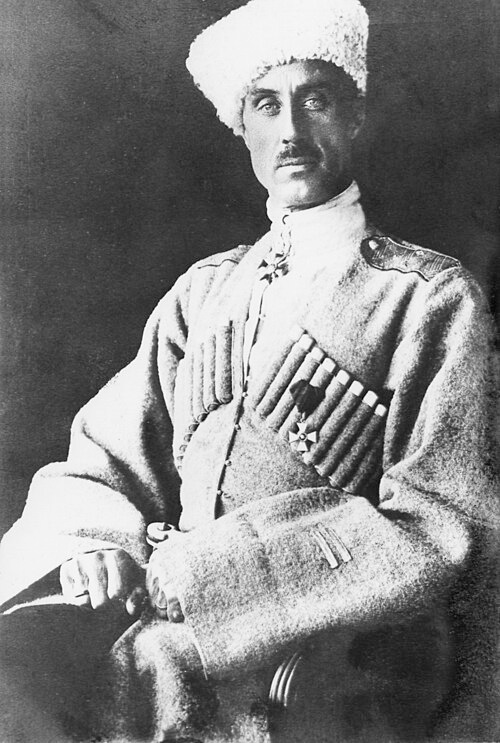
Pyotr Nikolayevich Wrangel (August 15 (27), 1878, Novoalexandrovsk, Kovno Governorate, Russian Empire – April 25, 1928, Brussels, Belgium) was a Russian military leader and one of the principal commanders of the White movement during the Civil War.
Background and Education
Wrangel came from the old noble Wrangel family of Danish origin. His father, Baron Nikolai Yegorovich Wrangel, was an entrepreneur and public figure, while his mother, Maria Dmitrievna, was well known in society. Pyotr Wrangel received his education at the Rostov Real School and later at the Mining Institute in Saint Petersburg, which he graduated from in 1901.
Participation in Wars
Early in his career, Wrangel served in the Russo-Japanese War (1904–1905) and the First World War (1914–1918), where he proved himself a talented commander. He was awarded the Order of St. George, 4th Class, for his actions on the front.
The Civil War
After the October Revolution of 1917, Wrangel became one of the leaders of the White movement. He was appointed commander of the Caucasian Volunteer Army and later took command of the Russian Army in Crimea. In 1920, after a series of setbacks and the advance of the Red Army, his forces were forced to retreat. Wrangel organized the evacuation of the White forces from Crimea, which became one of the largest exoduses of the White Guard.
Exile and Life in Europe
After the evacuation, Wrangel lived in Turkey and later in Europe, mainly in France and Serbia. He actively participated in the life of the Russian émigré community and became one of the founders of the Russian All-Military Union. Wrangel died in Brussels in 1928 and was buried in Belgrade.
Legacy
Pyotr Wrangel left behind numerous memoirs and recollections that continue to attract the interest of historians. His figure remains controversial: for some, he is a hero and defender of Russia; for others, a symbol of the White Guard movement.