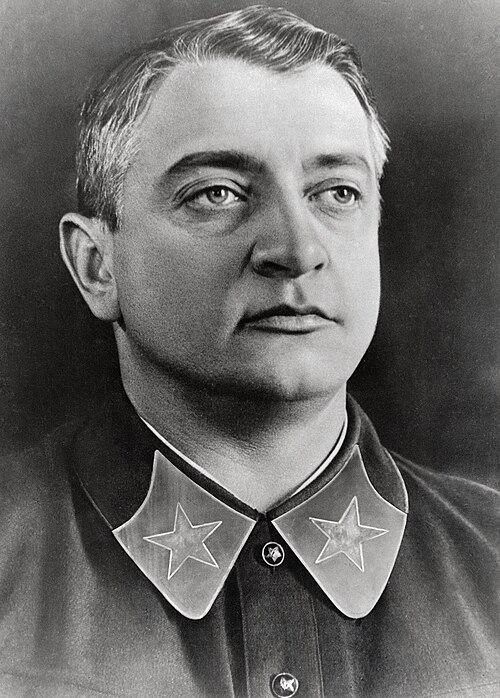
Early Life and Education
Mikhail Nikolayevich Tukhachevsky was born on February 16, 1893, in the village of Aleksandrovskoe in the Smolensk Governorate, into a noble family. His father, Nikolai Tukhachevsky, was a railway engineer, and his mother, Alexandra Tukhachevskaya, came from a noble family. In 1911, Tukhachevsky graduated from the Aleksandrovskoe Military School in Moscow and began serving in the Imperial Army with the rank of second lieutenant.
World War I
When World War I broke out in 1914, Tukhachevsky was sent to the front. He took part in the fighting on the Southwestern Front and distinguished himself as a brave and capable officer. In 1915, he was wounded and captured by Austrian forces, spending two years in a prisoner-of-war camp.
Civil War
After the October Revolution of 1917, Tukhachevsky returned to Russia and joined the Red Army. He quickly advanced through the ranks, becoming one of the closest associates of Leon Trotsky, the People’s Commissar for Military and Naval Affairs. Tukhachevsky took part in several key battles of the Civil War, including the defense of Tsaritsyn (now Volgograd) in 1918 and operations on the Southern Front. His military talents and determination were highly valued by the leadership.
Military Reform and Theoretical Works
After the Civil War, Tukhachevsky became one of the main architects of Red Army reform. He actively promoted the ideas of mechanization and motorization of the armed forces, as well as the development of new tactics and strategies. Tukhachevsky authored numerous military works in which he presented his ideas on future wars and the necessity of army modernization. His works, such as Questions of Modern Warfare and Operational Art, became classics of military literature.
Career and Achievements
In the 1920s and 1930s, Tukhachevsky held several high-ranking positions in the Red Army:
• 1921–1924: Head of the Military Academy of the Red Army.
• 1924–1928: Commander of the Leningrad Military District.
• 1928–1931: Head of the Red Army Combat Training Directorate.
• 1931–1936: Commander of the Leningrad Military District.
• 1936–1937: Deputy People’s Commissar of Defense of the USSR.
Tukhachevsky was also one of the initiators of creating tank and air forces, making him one of the pioneers of modern military technology. He actively promoted the concept of deep operation, which involved using tank and aviation units to break through enemy defenses and advance deep into the rear.
Arrest and Execution
In 1937, during the height of Stalin’s purges, Tukhachevsky was arrested on charges of participating in an anti-Soviet conspiracy. Despite the lack of evidence, he was sentenced to death and executed on June 12, 1937. Tukhachevsky was rehabilitated only in 1957, after Stalin’s death.
Legacy
Mikhail Tukhachevsky left a significant legacy in military theory and practice. His ideas and concepts influenced the development of Soviet military doctrine and continue to be studied in military academies around the world. Tukhachevsky is considered one of the most talented and forward-thinking military theorists of the 20th century. His works and ideas had a profound impact on the evolution of modern military strategies and tactics.