Early Years
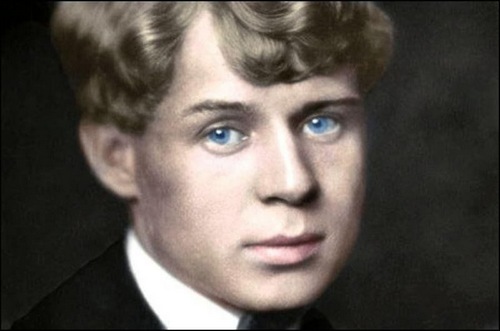
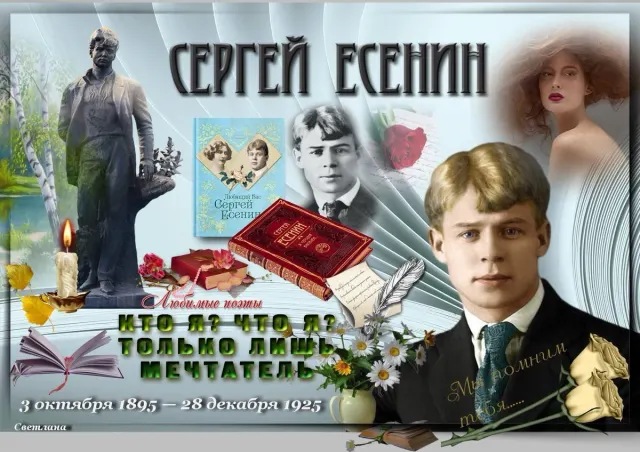
Sergei Alexandrovich Yesenin was born on October 3, 1895, in the village of Konstantinovo in the Ryazan province. He was the third child in the family of the peasant Alexander Yesenin and his wife Tatyana. From childhood, Yesenin showed an interest in literature and poetry, and he wrote his first poem at the age of nine. In 1912, he graduated from the village school and moved to Moscow, where he began to take an active part in literary life.
Literary Career
Yesenin began publishing his poems in 1916, and soon his work attracted the attention of the literary community. In 1917, he released his first collection, Radunitsa, which became successful and brought him fame. His poetry was distinguished by vivid imagery, melodiousness, and deep emotion. Yesenin often turned to themes of nature, love, and the Russian countryside, which made his poetry relatable and understandable to a wide circle of readers.
Influence and Style
Yesenin was associated with various literary movements, including Acmeism and Symbolism. His style combined folk motifs with personal experiences, creating a unique atmosphere in his poems. He used simple yet expressive imagery, which made his poetry accessible and emotionally rich.
Personal Life
Yesenin was known for his turbulent romances. In 1917, he married the actress Zinaida Reich, with whom he had a son. However, their marriage was unstable, and in 1921 they separated. The poet also had a relationship with the famous dancer Isadora Duncan, which drew additional public attention to him. These relationships often became sources of inspiration for his work, but also causes of personal suffering.
Later Years
In the 1920s, Yesenin experienced a creative crisis and personal difficulties. His poems became increasingly dark and pessimistic, reflecting his inner turmoil and disappointments. He traveled extensively, seeking inspiration, but his condition worsened. In 1925, he published his final collection, Collected Works, which received mixed reactions.
Death
On December 28, 1925, Yesenin was found dead in the Hotel Angleterre in Leningrad. The official version is suicide, but the circumstances of his death remain disputed. The poet left behind many unfinished works and drafts, which add an element of mystery to his legacy.
Legacy
Yesenin is considered one of the greatest poets of Russian literature. His poems continue to be studied and performed, and his life and work inspire many artists, musicians, and writers. His poetry remains relevant and in demand, and his way of life and tragic fate evoke interest and sympathy among readers.
This is a city. It’s still early. Half-light, half-shadow.
Then the sun touches the rooftops, but not yet the walls.
And then, suddenly, a window lights up in the wall.
A piano sound appears. The movie begins.
The Earth awakens, sways, begins to spin.
Ah, projectionist, for heaven’s sake, what are you doing to me!
That sharp, straight beam, that strip of light,
makes me weep and laugh for two hours,
be part of all that happens, drink, love, sink to the bottom…
My life, my cinematograph, my black-and-white film!
Who wrote the script? What strange dreamer,
this director — both mad and brilliant?
How freely he edits together pieces
of rapture and despair, of joy and melancholy!
He never forgives an actor a poorly played role —
whether comic or tragic, fool or king.
Oh, how hard, how beautiful it is to be a living character
in this drama, where between the start and the end
there are only two hours — or even less, just one moment…
My life, cinematograph, black-and-white film!
I don’t notice right away how you suffer from the lack of vivid colors,
from your unintentional muteness. You still scream in silence,
you first capture me with the eloquence of gestures
that replace words. And your actors hurry —
they run, they run — and down their pale white cheeks
flow black tears. I believe those black tears, and I weep with them…
My life, cinematograph, black-and-white film!
You gather experience, and through the years,
slowly but surely, you gain sound and color.
Your sound is harsh in those years, the voices too loud,
the dawns too red, the eyes too blue,
the stain on your hand too dark with blood…
My life, your early age, the childhood of our cinema!
Then shades will come, then half-tones,
that skill, that freedom which only maturity can bring.
And later, even that maturity will one day become
the childhood, the first steps of those who come after us —
to live, to take part, to drink, to love, to sink to the bottom…
My life, my colored, panoramic film!