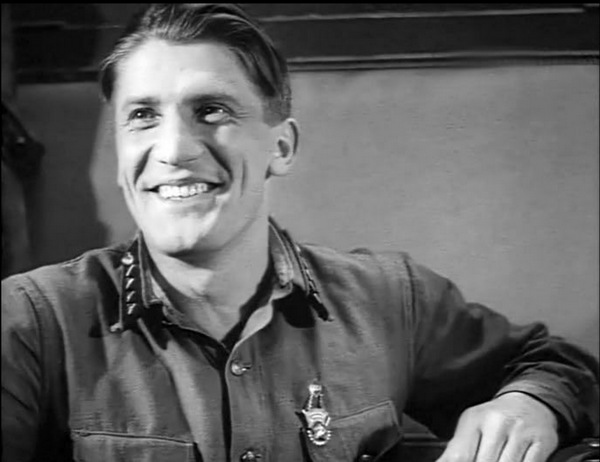
KRYUCHKOV, Nikolai Afanasyevich (January 6, 1911, Moscow — April 13, 1994, same place), Russian actor; People’s Artist of the USSR (1965); Hero of Socialist Labor (1980); laureate of the USSR State Prize (1941 — for his role as Klim Yarko in Tractor Drivers).
He studied acting at the Moscow Central TRAM (Theater of Working Youth). Until 1930, he worked at the Trekhgornaya Manufactory as an engraver-pattern maker. Beginning in 1931, he became an actor at TRAM.
He entered the film industry in 1933; his first role was Senka in Boris Barnet’s Outskirts. From 1934 to 1936, he was an actor at the Mezhrabpomfilm studio (now the Gorky Film Studio), and later at the Film Actor Studio Theater. He became one of the most frequently cast actors in Soviet cinema.
When he showed up at the “Udarnik” cinema for the first film premiere of his life—coming straight from swimming in the Moskva River, wearing rubber slippers and with sand in his hair—the ticket inspectors refused to let him in for a long time: the young man looked nothing like a movie actor. He looked like an ordinary viewer trying to sneak into the cinema without a ticket. It was 1933, the beginning of the sound film era, and how could the inspectors have guessed that from then on, resemblance to the ordinary viewer—direct similarity—would become the main virtue of a new generation of film actors, and that audiences would love them passionately precisely for this familiarity?
Compared to other legendary audience favorites—Boris Andreyev, Mark Bernes, Pyotr Aleynikov, and Boris Chirkov—Kryuchkov may have been less technically refined, but he became the symbol of the prewar era because he dissolved into it completely. Time itself, not directors, revealed him as its ideal hero—its ideal executor.
Directors valued him above all for his natural reactions, complete organic presence, and ability to merge fully with the situation. It was no coincidence that he was discovered for cinema by one of the most organic Soviet directors, Boris Barnet, in Outskirts (1933) and By the Bluest of Seas (1935).
The qualities that attracted Barnet to the young TRAM actor—a former worker from Trekhgorka—were not heroic but rather lyrical. But once the era took on an openly heroic character, Kryuchkov became its most typical hero thanks to the same ability to merge with circumstance.
In the 1930s–40s he portrayed all the era’s standard heroes: border guards (At the Border), Stakhanovite miners (September Night), pilots (Brother of a Hero), and tank operators (Tractor Drivers, A Guy from Our City). In every role he embodied everything required of the hero of those years, performing every feat as deftly as he had handled shoemaking tools in Outskirts. Beyond that, he was always ready to sing, dance (having trained under Natalia Ghan at TRAM—the famous “Mademoiselle Mendès” from Barnet’s films), and play the accordion—demonstrating all the traits that elicit public admiration: “Now that’s an actor!”
All this gave Kryuchkov the right to represent the viewer on screen—the viewer who immediately recognized in the hero an idealized version of himself endowed with the skills needed to qualify as a hero of the time, a time that acknowledged no inner conflicts or complexities.
However, these same qualities turned against Kryuchkov in the second half of the 1940s: he was not monumental enough for the heroes of the “Grand Style.” After appearing during the war in adaptations of canonical plays by Konstantin Simonov (A Guy from Our City, Russian People, the latter released as For the Motherland) and Alexander Korneichuk (The Front), and then in the very popular but harshly criticized comedy Heavenly Slug, Kryuchkov faded into the background. His most interesting work of the period—based on E. Kazakevich’s The Star—was released only after Stalin’s death.
When he returned to the screen in the 1950s, acting intensively, he had become an inseparable part of the cinematic reality of Soviet film—but he was no longer a hero of the present. From then on he became the hero of past eras: Russia’s historical past (Maksimka, The Cold Sea), the Civil War (Troubled Youth, The Poet, The Forty-First), and the Great Patriotic War (The Immortal Garrison, Ballad of a Soldier, Far in the West, Gold, Mission of Extreme Importance).
In films about the contemporary world of the 1950s–80s, he played wise, respected, all-understanding veterans (The Address of Our House, When September Comes, The Telegram, My Friend Uncle Vanya, The Townspeople). In all these works, Kryuchkov’s screen persona related to his cinematic past, not to the fate of any real-life viewer-prototype.
He existed freely and intelligently in the stylized ideal world of cinema. But aligning his hero with reality proved catastrophic, as shown in his finest work of the next decades—especially in V. Skuybin’s Cruelty and The Trial, in I. Kheifits’s The Rumyantsev Case, in S. Tumanov’s TV film The Nests, and finally in G. Daneliya’s Autumn Marathon.
In these roles, Kryuchkov’s hero is a man bewildered by the challenges of real life. It became clear that Kryuchkov was less a hero than a symbol of a time that insisted on its own heroic tone, leaving no room for the character’s personal choice. Therefore, the heroism of such characters was fundamentally conditional.
The problem of choice terrifies and confuses him; he instinctively tries to shift responsibility onto those around him.
Cinema’s love for Kryuchkov, which allowed him to remain in the memory of audiences and filmmakers until his last days, was—beginning already in the 1950s—a nostalgic love, a yearning for a time that freed (or tried to free) a person from the burden of personal choice.